Showing posts with label heating system. Show all posts

Thursday, February 3, 2011

Fixing Someone Else's Mistakes, Again (Part Two)

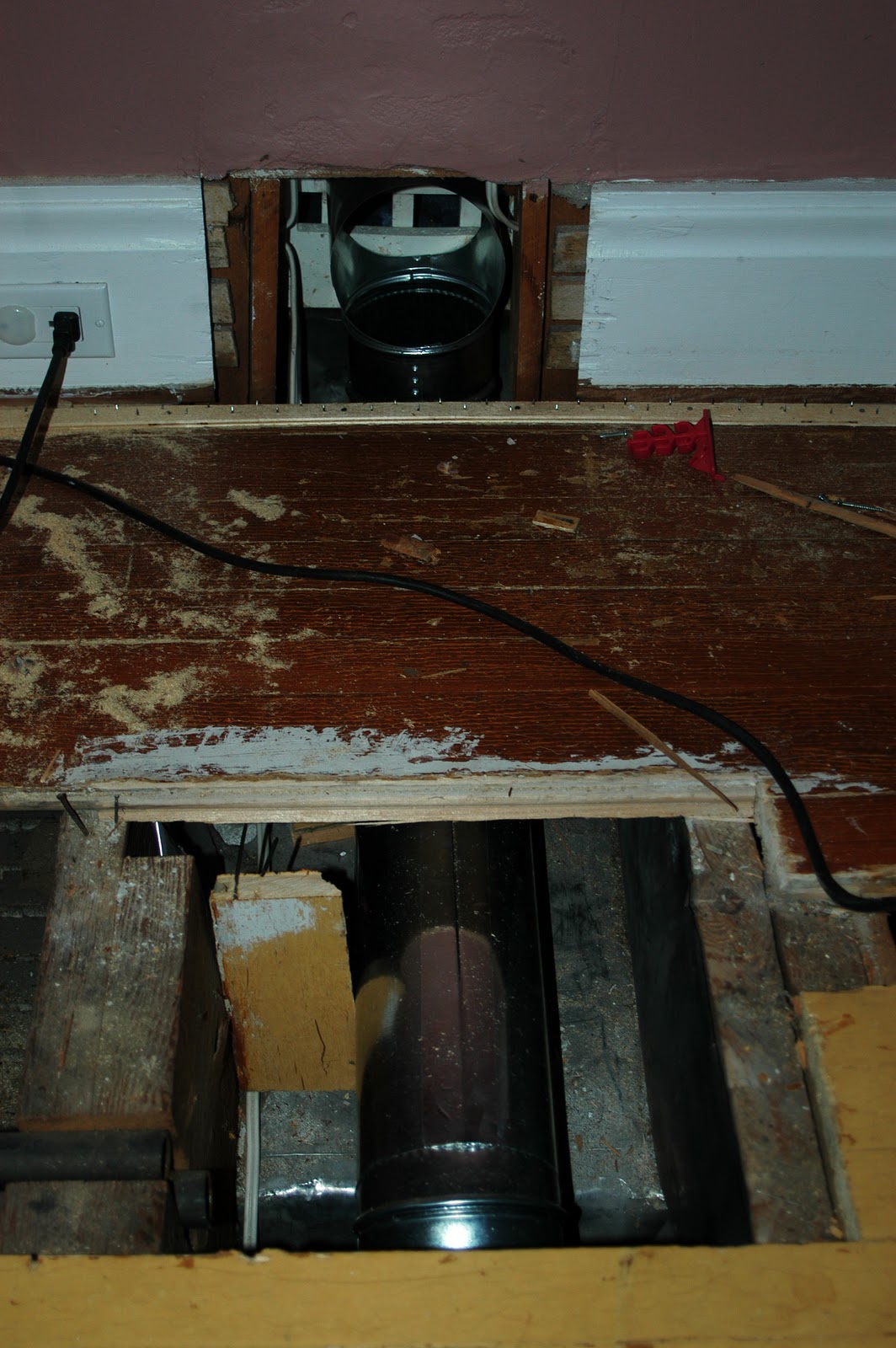
So with the fabric conduit removed, the 80 year old hot and return pipes cut out of the way, and the 120 year old large diameter vent pipe pulled up and out of the wall, I was then able to measure, cut, connect and install the five inch conduit to carry heat up to the two front rooms.

Now instead of heat carried via 6 inch contuit in the basement, and then flexible fabric tube to the floor near the heat registers, it runs along the same conduit in the basement, steps down to 5 inch rigid conduit up the wall, across the floor, and up to a 5 inch tee that has been specially cut to fit in place in between the two registers serving the front rooms. The photographs below show how this was installed.


Monday, December 6, 2010

Fixing Someone Else's Mistakes, Again

Just before the old furnace died in the spring, there was a substantial decrease in airflow from the shared vent serving Rudi's room and the guest bedroom. I thoroughly checked the ducting in the basement, could not find the problem, and then the furnace promptly quit. With the new furnace being installed and working perfectly, I began to look into the problem again. and found the problem, and a few other interesting things, including a live Loomex electrical cable that had been pulled up alongside the old heating vent, and run along the heated space to an electrical outlet close by!


Above Left: The floor opening located nearly directly above the first floor wall. The two grey pipes are the hot and cold supply lines for the hot water heating system installed sometime in the 'thirties possibly. The heat from the forced air furnace is directed up the wall - the black space, to the right under the floor, and then up a bit into the heating vent located at the gap in the baseboard.

Above Right: A closer view down the wall cavity, revealing another interesting thing. The round tube standing in the wall cavity must have been installed before the hot water supply pipes, meaning it is original to the construction of the house in 1888. From that time until the oil hot water system was put in place, the second floor was heated by this 'gravity' heating sysstem, with one feed serving two bedrooms at the front of the house, and another  feed serving two bedrooms at the back of the house.

When the house was converted to forced air natural gas heating in 1987, a 6" diameter flexible conduit duct was pulled up inside the original 8" diameter carbon steel duct, placed below the old water supply pipes, and then simply left in the space between the joists pointing toward the outlet vents. Over the years, the conduit must have popped out of place, slipped back into the vertical duct, and then simply blasted hot air against the floor and into the joist space running the length of the room, with a consequent significant reduction of airflow from the vents.


Above Left: The old cast iron hot and cold pipes are cut and removed, and the original 8" diameter duct has been pulled out. The reciprocating saw with metal cutting blade chewed through the pipes in under 5 seconds each. The circular saw was used to cut the floorboards, and the flashlight required to see down the inside of the wall.

Above Right: A  view down the wall cavity with the original duct removed. The two wooden studs are the left and right wall studs, making the wall about 10 inches wide. Unfortunately, the gap between the two is open to the inside surface of the exterior double brick wall, a probable significant source of heat loss, as all of the cold from the inside surface of the much of the front wall can pass into the house through this gap.

Sunday, November 21, 2010

The New Furnace Arrives


Ken and Domenic from Dave Davies Air Conditioning Heating and Refrigeration installed a beautiful Lennox Elite Series G-61-V Two Stage variable DC fan 90,000 BTU high effieciency Energy Star rated furnace on Wednesday. Here Ken is illustrating the Ontario Workplace Health and Safety Board approved method of conducting the initial tests of the new unit, which is said to reduce lower back injuries by a significant margin. Note these newer furnaces are much more compact and closer to the ground than the older models they are replacing!


I inquired about the very fancy Honeywell Prestige thermostat, just to see if it was worth considering. It was an additional $350 on top of the furnace which had a standard thermostat included. Since I was the only one who had ever even asked about one, and Dave's son had just pulled one out of his own house in favour of a newer model that chatted with his iPhone, they provided me his at no additional charge. Sweet! I will thoroughly test this state of the art thermostat over the next few weeks, then offer my opinions.


The thermostat comes with a remote control, which allows you to access basic functions from anywhere in the house.


A close up view of the new unit, with new inlet and exhaust piping, and minor plenum modifications to fit the smaller size unit. The Space-Guard air filter was kept, as it is in essentially pristine condition, apart from some cosmetic rusting on the back of the unit.


And for the final verdict:
Total estimate price (furnace, installation, condensate pump, new inlet and exhaust, plenum mods, and basic Honeywell thermostat): $3900 + HST = $4407.
Total actual price (furnace, installation, condensate pump, new inlet and exhaust, plenum mods, relocation of furnace switch, and Honeywell Prestige thermostat): $3900 + HST = $4407.

Three other local companies provided similar estimates at $3700 (plus thermostat), $4000, and $4450, all prices plus HST. And no, even though you see high efficiency gas furnaces advertised as low as the high teens and low two thousands, those prices are inclusive of all potential rebates, and are generally for made in china single stage ac fan furnaces, which barely meet 90% AFUE standards. If you want a manufactured in North America two stage furnace, with variable speed DC motor, EnergyStar rated, the going rate is around $4000 plus HST.

Additionally, the installation qualifies for an OPG rebate of $125, a manufacturers rebate of $150, and the province's eco-energy rebates of $650 will also apply (less the net cost of $325 for the testing) so the final price will be $3807

Tuesday, November 9, 2010

Furnace Sizing: Heat Loss Calculations

Since I am of the opinion that our broken down hunk of junk furnace is grossly oversized for the heating requirements of the house, I decided to do a heat loss calculation to do things properly. The existing furnace is a 130,000 BTU 92% efficiency, which I really think is in the order of half again too big, and that something like 90,000 BTU should have no issues keeping the house warm.

I found the CMHC website which has a fantastic article on replacing a furnace, including a detailed method of doing a heat loss calculation based on your fuel bills.


The only other information needed is data on heating degree days for the period you are planning to calculate, which are available at these two sites. The first link will have you search for a local weather station, and provides historical 30 year averages for the station selected. The second link provides a Canada wide average for each of the last ten years. Specific HDD values vary by location, and you should try to get both localized data, and compare this with the Canadian data, especially if you live in places that are warmer (Victoria BC) or colder (Fort McMurray AB) than the Canadian average.


Looking at our Union Gas bill covering November 2008 through February 2009 (actual consumption from Oct 21 2008 to Feb 17 2009), I then simply cut and paste the calculation portion of the text from the CMHC site, and went through adding my own numbers below:


Total gas consumption from December to March = 2620 m3

Estimating 5% of gas is used for hot water, gas consumption during the period for heating = 2620 * 0.95 = 2490 m3

Heating degree days for that period (from Environment Canada) = 2680 HDD

Heating consumption by degree day = 2490 m3/ 2680 HDD = 0.929 m3/HDD

Heating consumption (difference of -35 coldest, from 18 ambient) at 53 HDD/day = (53 HDD/day)(0.929 m3/HDD) = 49.2 m3/day

Where gas has an energy content of 37.5 MJ/m3, and the existing furnace has an efficiency of 92 per cent, then:

Heat loss at 53 HDD/day = (49.2 m3/day) (37.5 MJ/m3)(0.92) = 1697 MJ/day or (divide by 24) 70.7 MJ/h

According to the energy content of electricity, 3.6 MJ/h = 1 kW, then 70.7 MJ/h = 19.6 kW

This heat loss would require a furnace that produces an output of 19.6 kW or about 66,900 Btu/h (1 kW is approximately 3,412 Btu/h).

If we allow the CAN/CSA F280 permissible oversizing of 40 per cent, then the proper furnace sizing would be (1.4)(20,100 Btu/h) = approximately 93700 Btu/h.


The determination of the correct furnace size for a house is NOT an exact science. Ideally the furnace size that is most efficient for any house is the size that effectivly runs close to 'flat out' only on the absolute coldest day of the year. If it is too small, it will not be able to keep the house warm enough, and if too large, it has an easy time heating during extreme cold, and becomes less efficient in mild weather.

Tuesday, October 26, 2010

The Heating System - Time to Replace The Furnace!

A while back the furnace decided to stop functioning, thankfully timing it's failure in early April, so we didn't have to run out and buy a replacement. Two of those nice oil filled radiators, a spiffy quartz heater, and a reclaimed 1500 watt convection heater did the trick to keep the house warm enough til summer arrived. Now winter is coming up, and I am making the final decision on what to install! It turns out even though the Feds canned the Eco-Energy rebate program without warning (vote conservative if you like being screwed - thanks Steve!), the Provincial government has kept their grants in place, so I have an 'Eco-Energy Audit' scheduled for this week, and next week the new furnace should go in.

Interestingly, the existing furnace is (was) a Carrier Weathermaker SX high efficiency condensing gas furnace (92% AFUE) with a whopping 122,000 BTU output. I know enough about furnaces (which is just enough) to realize that 122 k BTU is huge, and considering that even on the coldest days the beast could pull the house up from its setback of 60 deg F to 69 deg F within an hour, and then maintain that running 20 minutes every hour, it seems there was no lack of capacity!

The owner of one of the companies I contacted laughed, and said 120 thou was fine for some of the larger older homes in Stratford, like the 5 and 6 bed mansions that run 5000 square feet or more, but the Field House is 2900 sf, plus 400 sf of sunroom and mudroom, which we tend to restrict the heat to in the winter. He suggested 90,000 BTU as he has installed that size in a number of similar size and age homes with great results. The previous owners of the house left the mudroom and sunroom doors open all year, and if they heated the place to the low 'seventies, the furnace may have got the occasional solid workout!

It looks like a choice between Ida Red Apples and Ida Red Apples, as I mull over the inconsequential differences between a Ruud high efficiency (95%) two stage burner condensing gas furnace with variable speed DC blower fan motor, and a Lennox high efficiency (95%) two stage burner condensing gas furnace with variable speed DC blower fan motor, either of which will set me back around $4000, less roughly $450 in net rebates after the audit is paid for.